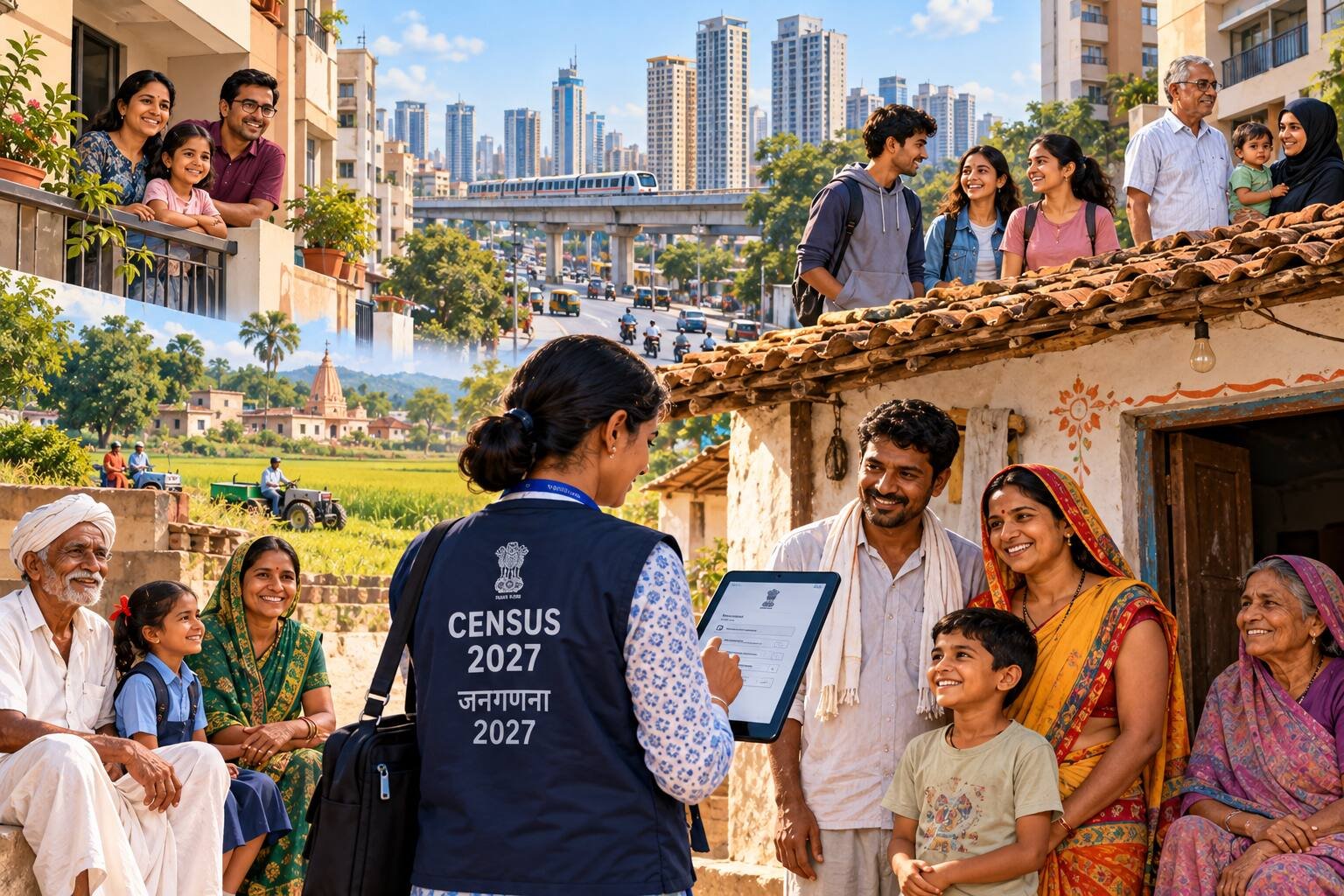
A society is constantly changing. Families become smaller, cities grow, people move from one place to another, new occupations emerge and the way people live also changes with time. In a country as large and diverse as India, understanding these changes is important not only for researchers but also for governments and communities.
This is why the Census 2027 is more than just a count of India’s population.
The Census is one of the largest exercises undertaken by the government. The upcoming Census is being conducted in two phases, with the first phase covering house listing and housing conditions and the second phase focusing on population enumeration. The government has also decided to conduct the exercise digitally for the first time, while giving citizens the option of self-enumeration through an online portal.
The first phase has already been completed in many parts of the country during 2026. In Maharashtra, for example, house listing and housing census work was carried out between 16 May and 14 June 2026. Enumerators collected information through a mobile application, covering questions related to houses, household amenities and assets.
At first glance, questions about a house, its facilities or the number of people living in it may appear routine. But together, such information can tell us a great deal about how Indian society is changing.
For example, information about housing and household amenities can help reveal differences between regions and communities. Population data can help governments understand where people live, how populations are changing and what kinds of public services may be needed. Data on education, migration and other socio-economic characteristics can also provide a broader picture of the country.
There is another important aspect of Census 2027. The government has said that caste will be enumerated in the second phase of the Census. The questions for this phase, including those relating to caste, are to be finalized and notified before the second phase begins.
The digital nature of the Census also reflects a broader change in Indian society. Government services and public administration are increasingly using technology to collect, manage and process information. At the same time, the government has stated that personal Census information will remain confidential and that only aggregated information will be published.
But the real value of a Census does not lie simply in producing a large set of numbers. Its importance comes from what those numbers can help us understand.
India today is very different from the India of the last Census in 2011. More than a decade has passed, during which cities have expanded, migration patterns have changed, technology has become deeply connected with everyday life and household aspirations have evolved.
Census 2027 therefore offers an opportunity to understand India as it is toda, its families, communities, living conditions and demographic changes.
A society cannot plan effectively without knowing itself. The Census is, in many ways, a mirror of the country, and Census 2027 may give India one of its clearest pictures of how its society has changed.